AI platforms are sending orders your tools can't see.
Customers are buying through AI. Someone tells ChatGPT "find me a lightweight rain jacket under $80," and three clicks later they've checked out — sometimes without ever visiting the store. From the merchant's analytics, the order looks normal. It's not.
AI-acquired customers behave differently. They buy exactly what the AI recommended and nothing else — no browsing, no impulse adds, no return visits. The order comes in, the revenue looks fine, and nobody notices that these customers spend less per order, come back less often, and have lower lifetime value.
This is invisible to every analytics tool merchants use. Shopify's native attribution can tell you an order came through a partner channel, but it frequently misidentifies the specific AI platform, lumps AI-referred traffic together with direct visits, and misses patterns entirely when the purchase happens inside an AI assistant.
The result: merchants are acquiring a growing percentage of customers through a channel that silently erodes their unit economics — and they have no idea it's happening.
Detecting, measuring, and closing the AI Commerce Gap.
Three things: a detection engine that classifies every incoming Shopify order by AI involvement, an analytics layer that quantifies the revenue gap, and an automated recovery system that closes it.
The detection engine evaluates each order against multiple signal layers — Shopify's native channel metadata, referrer domains, UTM parameters, order tags, and checkout URL patterns — producing both a classification and a confidence score. It detects 14 AI platforms including ChatGPT, Perplexity, Google Gemini, Claude, Copilot, Grok, and DeepSeek.
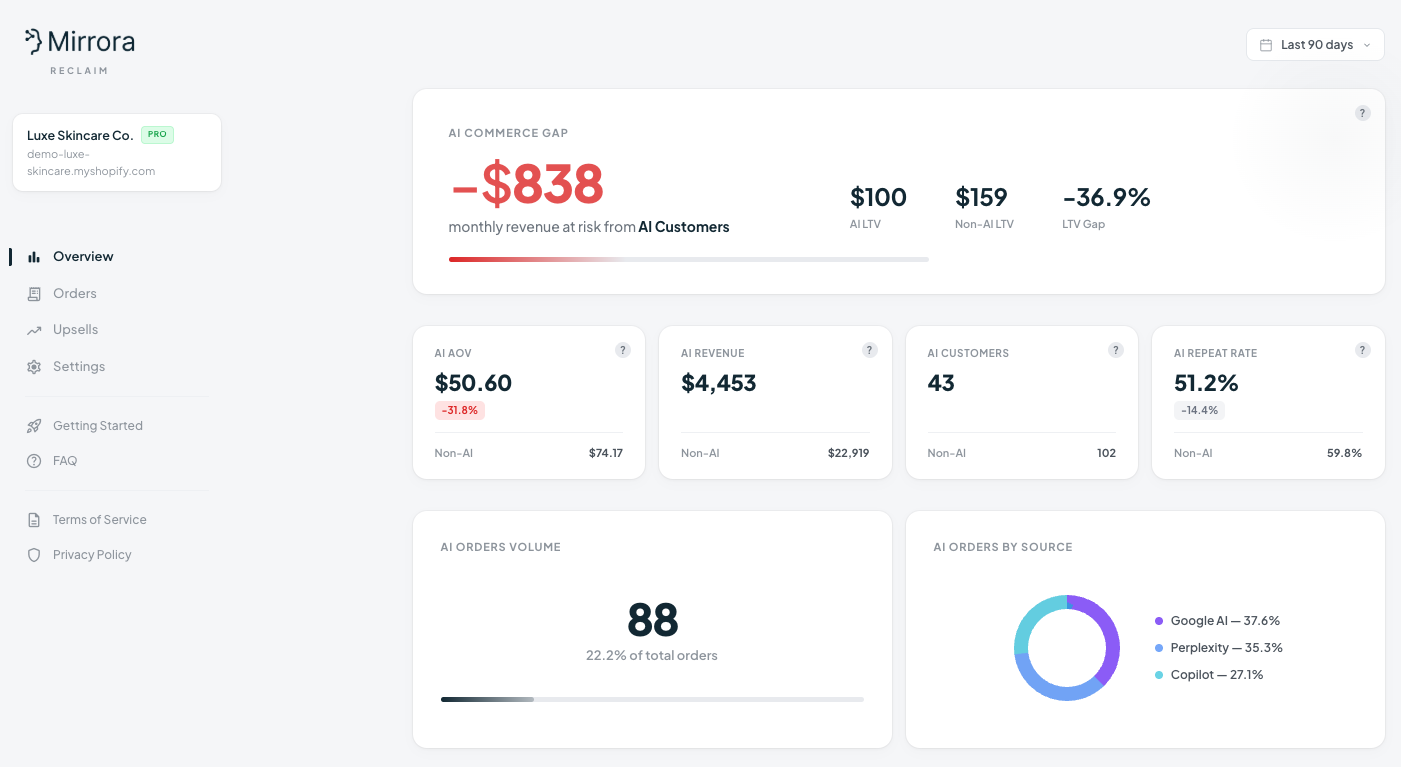
On top of detection, the analytics layer quantifies the AI Commerce Gap: the measurable difference in average order value, lifetime value, and repeat purchase rate between AI-acquired and organic customers. The headline metric — Monthly Revenue at Risk — shows merchants exactly how much the gap costs them, expressed as a dollar figure.
Multi-signal classification with confidence scoring.
The system evaluates every order through a layered signal pipeline, cross-referencing Shopify's native attribution with checkout metadata to produce both a classification and a confidence score.
Signal Layer 1 — Channel metadata
Shopify's channelInformation identifies partner sales channels. Cross-referenced with app installation data to map to specific AI platforms.
Signal Layer 2 — Referrer & UTM analysis
Referrer domains and UTM parameters are evaluated against known AI platform patterns. High-confidence signal when present, but often absent for AI direct checkout orders.
Signal Layer 3 — Checkout URL & order tags
Checkout URL patterns and Shopify order tags that distinguish AI-originated purchases from organic referral-less orders like bookmarks or saved links.
Signal Layer 4 — Behavioral fingerprint
Order characteristics — single-item carts, no browse history, no account creation — that correlate with AI-mediated purchases. Supporting signal that raises confidence when combined with other layers.
Recovery targets AI direct checkout orders specifically — the segment with the widest AOV shortfall. The upsell appears in the order confirmation email, which is the single guaranteed touchpoint with customers who never visited the store. A recommendation engine picks the right product for each order — catalog-aware, price-banded to the impulse range, and checked against live inventory and margin — then packages it into a pre-filled one-click Shopify checkout with free shipping.
Attribution in a world without page loads.
Visibility into a channel that didn't exist two years ago.
AI commerce is early. Most Shopify merchants have a small but measurable percentage of AI-originated orders today — enough to detect the pattern, not yet enough to dominate revenue. The gap exists, it's growing, and until now there was no way to see it.
Reclaim gives merchants the instrumentation to track AI commerce from day one. The system processes orders in real time via Shopify webhooks, with historical backfill covering 90 days of past orders on installation. Analytics are pre-computed daily — the dashboard reads from cache, never computes on the fly.
Merchants see which AI platforms send orders, whether those orders are direct checkout or AI-suggested, how AI cohorts perform versus organic customers over 30/60/90-day windows, and whether AI-acquired customers eventually become organic buyers. The headline metric — Monthly Revenue at Risk — puts a dollar figure on the gap so merchants can decide when to act.
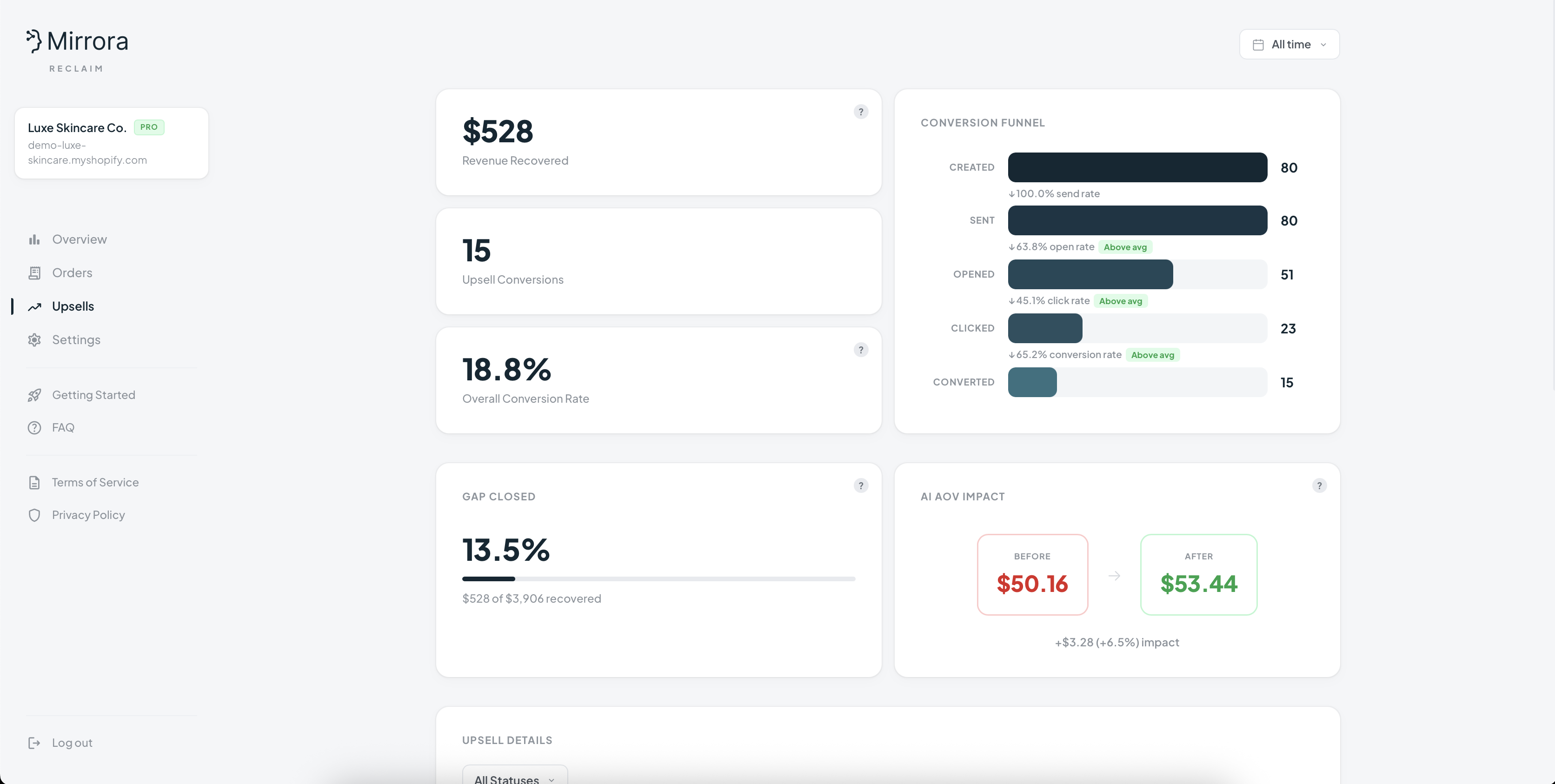
When they do act, the upsell engine targets AI direct checkout orders automatically — the segment with the widest AOV shortfall. The full recovery funnel is tracked end to end: offers generated, emails delivered, links clicked, purchases completed. Merchants tracking today will have months of baseline data when AI checkout scales across platforms — and the recovery system will already be running.
We build systems like this — and operate them in production.
Bring us the operation that's holding you back.
Get Started